

The word of the moment is “healthy”. As I speak with church and denominational leaders, they are very keen to make sure their churches are healthy. This is partly in response to several, very public, examples of high-profile churches that turned out to be far from healthy. It also reflects a genuine heart to see people flourishing, churches growing, and God honoured.
The challenge is, “What does a healthy church look like?” The responses I get are often vague. It is one thing to desire health, but it is hard to pursue it if you cannot define it.
The Limits of Binary Thinking
We tend to look at health in a binary way – that is, you are either healthy, or you are not.
Our conversations about health will be limited by the framework we use. Asking, “Are we healthy as a church, or unhealthy?” “Are we fine, or in crisis?” will only get us so far. We need a different framework and different questions.
If you were to ask me, “Richard are you sick? Do you need to see a doctor? Or are you well?” I could confidently reply, “I am well. Thanks so much for asking” That would be the end of the conversation.
However, if you were to ask me a different question, “Are you fit?” I would answer, “Well, yeah, you know – somewhat.” If you were to push the question, “No, Richard are you fit? Do you have all the nutrients, minerals, rest and exercise, you need to physically thrive?” I might squirm a little more, and respond, “Well, um, you know as much as the next person. Just don’t look too closely – somewhat.”
This different framework and questioning open up a very different conversation. Rather than the answer being an either/or, we realise that our fitness is a continuum, and we are all on it somewhere. In the same way, we can change the question to ask, “Is your church relationally, emotionally, spiritually, fit?” or if we pushed it further and asked, “Is your church fit in all these areas so it can thrive in all that God has called it to do and be?” This opens up a very different conversation. Many may reply like I did, “Well, as much as the next church, just don’t look too closely – somewhat.”
Over time I have identified five common levels of church health. This framework is not about judgement—it is about clarity. Clarity creates hope, and gives next steps for growth.
It may surprise you that this continuum does not start with “Unhealthy” and end with “Healthy”. It spans from “Unsafe” through to “Thriving”.
Where does your church on the church health continuum?
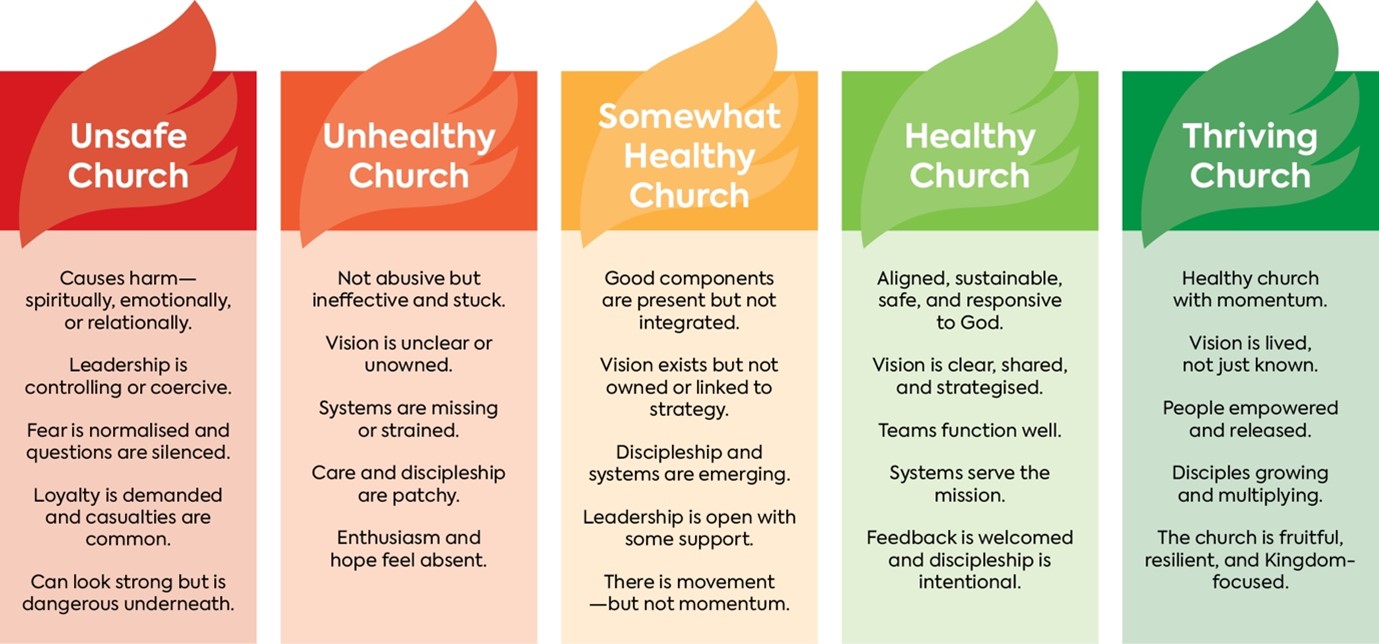
This is a church where people are being harmed—spiritually, emotionally, or relationally. The pain is real, but it can be difficult to recognise from the inside because the outcomes often look good. Faith language and growth numbers can mask the harm that is happening. As I said to one church leader, “Sometimes the numbers can be an anaesthetic to dysfunction.”
Leadership often misuses their power. Control, coercion, and manipulation are mistaken for strong leadership and culture setting. Questions are silenced. Fear is a part of the culture. If you raise a problem, you become the problem. Loyalty is strongly emphasised. Correction is often relational – people are either “in” or pushed out and even blacklisted.
There is often high turnover in staff and volunteers. The rearview mirror of the church is littered with casualties. This is not just unhealthy, it is spiritual and emotional danger.
Healing and restoration require deep repentance, courageous intervention, and competent external support.
An unhealthy church is not abusive, but it is detrimental. The vision may exist, but it is either unclear or unowned. There is often plenty of goodwill, but survival has become the unspoken norm. Mission drift is common—there is little genuine focus on reaching beyond themselves or growing people as disciples. Sunday services continue, and they are the primary focus. Systems are strained or absent, leadership is misaligned, and ministries are running on fumes. Meetings involve much talk, but little action or accountability.
Leadership may be passive, defensive, or simply tired—and often finds itself ignored or under attack.
What makes the issues harder to see is that many in these churches will say, “But we have great fellowship.”. Despite this, pastoral care can be patchy, inconsistent, or underdeveloped.
People may be burning out or coasting with expectations so low it becomes “sustainable” by default. Enthusiasm is low. Hope feels distant.
These churches are stuck, but with courage and the right support, they do not have to stay there.
These churches have many of the right components but often lack organisation and integration. Vision may be present, but it is not widely owned or connected to clear strategy. Discipleship and care are happening, but they are not yet robust or consistent.
Leadership is open to feedback and eager to grow. Some healthy systems and processes are in place, while others are still forming. Outreach exists but not yet fitted into a clear and consistent strategy plan.
Most people attend as consumers of the Sunday gathering. Some help out, but few feel a clear sense of purpose or ownership in a shared mission. The staff are not yet a team, and volunteers often lack organisation and support.
There is movement, but not yet momentum.
Conflict is mostly handled well, but relational triangles and blame patterns can still surface under stress.
These churches are on the right track, but need intentional support to fully embed health, alignment, and impact.
A healthy church is aligned, sustainable, and responsive to God and people. Vision is clear, shared, and actively shapes decisions. Leaders function as a team, with strong relational trust. They are compassionate, consistent, and listen well. People can safely raise issues and complaints and expect to be heard with grace and respect.
Systems serve the mission, not the other way around. Discipleship, pastoral care, and ministry are intentional and effective. Feedback is welcomed, and there is a sense of spiritual vitality and safety. Meetings have purpose and action follows.
People are serving with genuine willingness and enthusiasm, and not from pressure. Volunteers are organised, equipped, and celebrated.
The focus still centres on doing Sunday well, and people are mobilised to filling rosters and running services. People’s gifts and callings that do not fit this framework are left underdeveloped.
This church is well-positioned for growth—not just numerically, but in depth, unity, and influence.
A thriving church is a healthy church plus. It has moved beyond movement to momentum. It is fruitful, multiplying, and energised by Kingdom vision. Vision is clear, transferrable, and grounded in strategy. It is not just known, it is embodied. It shapes culture, drives decisions, and fuels mission.
Leaders are being raised up and empowered. People are not just attending but being mobilised to fulfil their unique calling and gifting. The church is focused less on rostering people for Sunday needs and more on releasing people into Kingdom impact.
There is expectancy, adaptability, and a culture of empowerment.
People are growing as healthy disciples. They are taking ownership for their emotional, relational, and spiritual growth. They are growing closer with Jesus and helping others do the same.
There is high investment in the local community. Mission is not just outreach—it is presence, partnership, and transformation.
Leaders, staff, and volunteers are sustainable and rested. They function from their strengths, passions, and sense of calling.
Thriving churches are not perfect, but they are resilient, fruitful, and marked by momentum.
The Church Health Continuum shifts the conversation. It moves us into awareness that creates action, and diagnosis that leads to development. It helps us name hidden strain, celebrate growing strength, and recognise what needs attention before it becomes a crisis.
It also gives us permission to ask for help. Every church has a growth edge. The question is not whether we are perfect, but whether we are growing.
This framework is not about assigning labels but creating hope.
Wherever your church sits on the continuum, movement is possible. Health is not a fixed state; it is something you grow into.
Take a moment to reflect: Where is your church on this continuum today? Is it unsafe, unhealthy, somewhat healthy, healthy, or thriving?
Does your leadership team have the shared language, trust, and clarity to talk honestly about where you are and where you want to go?
Remember: you do not need to be in crisis to need support. You do not need to be “broken” to reach out for help. Let us move beyond settling for “not sick” or “somewhat healthy”.
And start asking, “Are we fit for what God is calling us to?”
I am passionate about helping churches thrive and move towards greater health, alignment, and impact. If this is your heart too, I would love to partner with you. Together we can assess what you need and create a development plan. This may include:
If this would be helpful, let’s talk.
Email me on: richard@thrivingchurcheshq.com